
3D Printed Shoes: How Additive Manufacturing Is Transforming the Future of the Footwear Industry
1. Global Market Trends: Leading Brands Are Driving the 3D-Printed Footwear Revolution
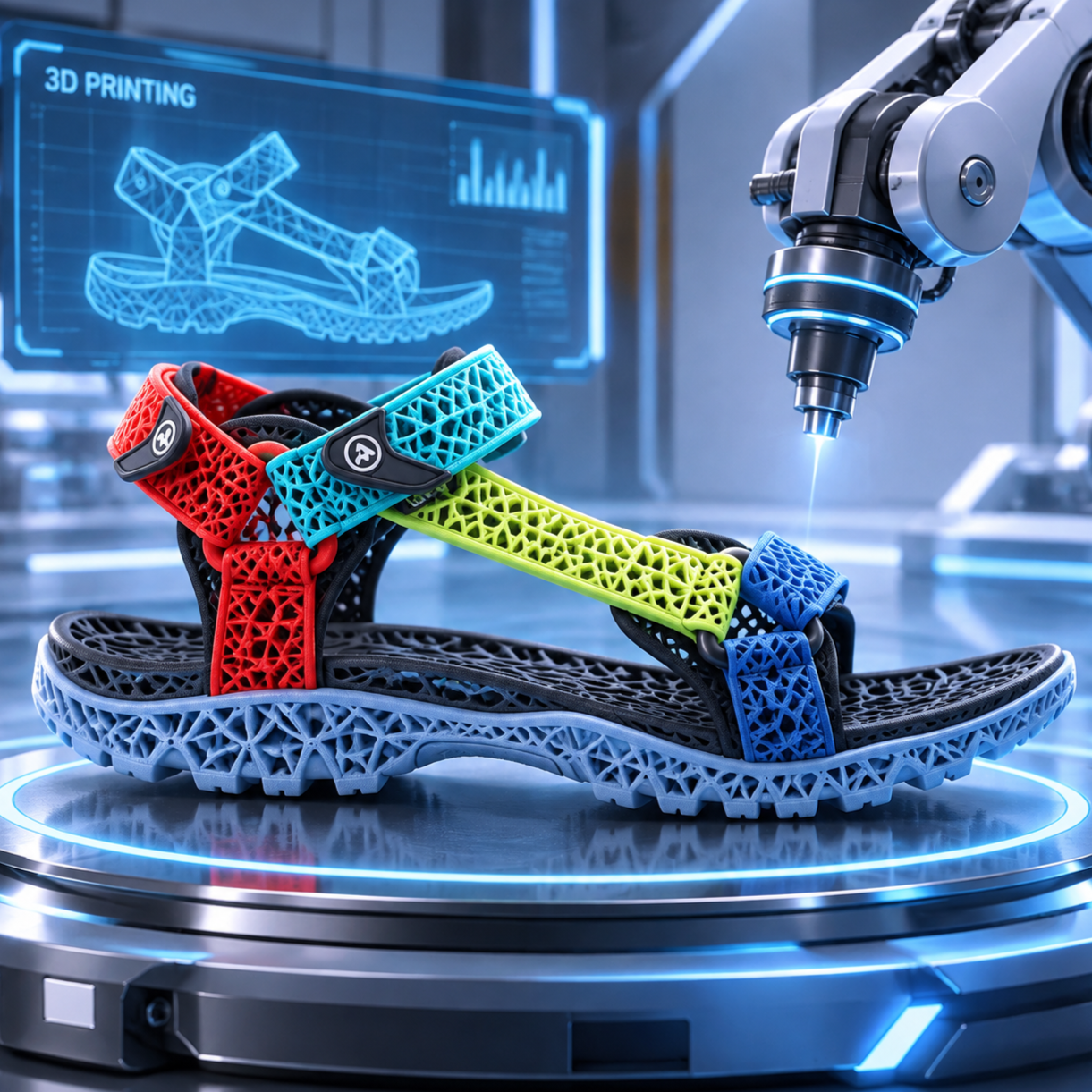
Three-dimensional (3D) printing, also known as additive manufacturing, is becoming an increasingly important innovation in the global footwear industry. What was once primarily used for product prototyping and experimental shoe design is gradually moving toward commercial footwear production. Leading brands, including Nike, adidas, and HUGO, are exploring 3D printing to create innovative shoe structures, improve product customization, and introduce new manufacturing possibilities.
Nike has made significant progress in this field through its collaboration with Zellerfeld, a specialist in 3D-printed footwear. In October 2025, Nike unveiled the Air Max 95000, its second footwear project developed with Zellerfeld. The shoe features a 3D-printed chassis combined with Nike Air cushioning units in the heel and forefoot. Nike also introduced Project Nectar, a specialized printing process designed to deliver durability, outsole traction, and distinctive design details. This development demonstrates how 3D printing can create footwear structures that are difficult to achieve through conventional manufacturing methods.
adidas has also continued expanding its additive manufacturing capabilities. Its earlier 4D footwear program introduced digitally designed lattice midsoles, while its 2026 Futurecool announcement demonstrated a further move toward integrated, single-piece 3D-printed footwear. Other developments include HUGO's collaboration with Zellerfeld on 3D-printed footwear and the growing application of personalized 3D-printed products in specialist footwear markets.
According to Grand View Research's 2026 market report, the global 3D-printed shoes market was valued at approximately USD 2.3 billion in 2025. The market is estimated to reach USD 2.7 billion in 2026 and is projected to grow to USD 8.8 billion by 2033, representing a compound annual growth rate (CAGR) of 18.6% between 2026 and 2033. These figures indicate strong commercial interest in additive manufacturing.
Several factors are driving this development. Consumers increasingly expect personalized products, distinctive designs, lightweight structures, and improved wearing comfort. Meanwhile, footwear brands are looking for manufacturing technologies that can reduce material waste, simplify product development, and support more flexible production. As a result, 3D printing is gaining attention not only in high-end sneakers but also in casual footwear, fashion shoes, sandals, and customized orthopedic products.
2. Materials Used in 3D-Printed Shoes: From Flexible TPU to Advanced Photopolymer Resins
Material innovation is one of the most important factors determining the performance and commercial potential of 3D-printed footwear. Unlike conventional footwear manufacturing, which commonly combines different materials for the upper, midsole, outsole, and insole, 3D printing can produce complex structures through precisely controlled material deposition or selective curing.
Thermoplastic Polyurethane (TPU) is one of the most widely studied materials for flexible 3D-printed footwear. It offers elasticity, flexibility, abrasion resistance, and resistance to repeated deformation. These properties make TPU particularly suitable for shoe uppers, midsoles, cushioning structures, and integrated footwear designs. Its flexibility also allows manufacturers to experiment with lattice structures that balance cushioning and support.
Lightweight TPU (LW-TPU) is another promising development. By incorporating a microcellular or foamed structure, this material can reduce footwear weight while maintaining flexibility and compressibility. A November 2026 study published in Fashion and Textiles by Springer Nature investigated fully 3D-printed shoes made with lightweight microfoamed TPU. The research found that LW-TPU offered a promising combination of lightweight construction, high compressibility, flexibility, and impact attenuation.
Polylactic Acid (PLA) is a bio-based thermoplastic commonly used in 3D printing. It is relatively easy to process and offers good dimensional stability, making it useful for prototypes, structural components, and experimental footwear designs. However, conventional PLA is comparatively rigid and less suitable for shoe areas requiring repeated bending and high flexibility unless modified or combined with other materials.
Photopolymer Resins and Specialized Elastomeric Materials are also used in certain additive manufacturing processes. These materials are particularly relevant to technologies such as digital light synthesis (DLS) and other resin-based printing methods. Depending on their formulation, they can provide flexibility, precise structural details, and controlled cushioning characteristics. Their application allows footwear designers to develop intricate geometries and integrated structures.
In the future, recycled polymers, bio-based materials, and advanced elastomers may create additional opportunities for more sustainable footwear production. However, material recyclability, durability, and environmental performance must be evaluated through actual testing rather than assumed from the printing process alone.
3. Advantages and Disadvantages of 3D-Printed Shoes
One of the biggest advantages of 3D-printed footwear is design flexibility. Traditional footwear production often requires multiple molds, components, and assembly procedures. In comparison, additive manufacturing can produce complex lattice structures, customized shapes, and integrated designs that are difficult or expensive to manufacture using conventional techniques. This gives footwear designers greater freedom to develop innovative products.
Another important advantage is personalization. By combining 3D foot scanning, digital modeling, and additive manufacturing, companies can potentially produce shoes tailored to individual foot shapes, pressure distribution, and biomechanical requirements. This is particularly valuable for orthopedic footwear, customized insoles, and consumers with specific comfort requirements.
Material efficiency and reduced inventory requirements are also potential benefits. Additive manufacturing builds products layer by layer, allowing manufacturers to use material more selectively than some traditional subtractive processes. Digital production files can also support on-demand manufacturing, reducing the need to maintain large inventories of finished products. Furthermore, integrated shoe structures may reduce the number of separate components and adhesive bonding processes.
However, 3D-printed footwear still has several disadvantages.
First, production costs can be high. Industrial 3D printers, specialized materials, software development, and post-processing equipment require substantial investment. For large-volume footwear orders, traditional injection molding, compression molding, and established assembly lines may remain more economical.
Second, production speed and manufacturing capacity remain important limitations. Printing an entire shoe can take considerably longer than producing conventional molded footwear, particularly when complex structures and customized designs are involved.
Third, wearing comfort and long-term durability require further improvement. A visually attractive 3D-printed structure does not automatically guarantee sufficient cushioning, flexibility, breathability, outsole grip, or resistance to repeated walking. Manufacturers must ensure that the finished product performs reliably under real-world conditions.
Therefore, 3D printing should currently be viewed as a complementary manufacturing technology rather than a complete replacement for traditional footwear production.
4. Technical Challenges and Future Outlook: What Comes Next for 3D-Printed Footwear?
Despite rapid progress, several technical challenges must be addressed before 3D-printed shoes can achieve widespread commercial adoption.
The first challenge is material performance and consistency. Footwear must withstand repeated compression, bending, abrasion, moisture, and temperature changes. Printed materials must maintain their mechanical properties throughout the product's service life. Achieving the right balance between softness, elasticity, structural stability, and durability remains difficult.
The second challenge is printing efficiency and scalability. Traditional footwear factories can produce large quantities through established molding and assembly processes. By contrast, printing complete shoes requires sufficient printer capacity, reliable production parameters, and efficient post-processing. Reducing printing time while maintaining consistent product quality will be essential for mass production.
The third challenge is structural optimization and quality control. A shoe must provide different levels of flexibility and support across the heel, arch, forefoot, and outsole. Designers need to optimize lattice density, cell geometry, wall thickness, and printing orientation to achieve the required performance. In addition, layer bonding and dimensional accuracy must be controlled to prevent structural weaknesses.
A 2025 review published in the International Journal of Bioprinting, involving researchers from Seoul National University and Seoul National University Hospital, highlighted the importance of combining 3D printing, biomechanics, and personalized foot design. The research also identified material science, manufacturing technology, and biomechanical optimization as important areas for future development.
More recent research published in Fashion and Textiles in November 2026 further demonstrates the progress being made. Researchers evaluated fully 3D-printed shoes using TPU, lightweight TPU, PLA, and lightweight PLA. Their findings suggest that lightweight microfoamed TPU has considerable potential for producing flexible footwear with improved impact absorption. Nevertheless, the study also emphasized the need for larger wearing trials, standardized comfort assessments, and long-term durability testing.
Looking ahead, the future of 3D-printed footwear will likely depend on the integration of advanced materials, artificial intelligence-assisted design, 3D foot scanning, and more efficient printing technologies. Rather than replacing every traditional manufacturing method, 3D printing is likely to create new opportunities in customized footwear, innovative shoe structures, premium fashion products, and specialized comfort solutions.
For footwear manufacturers, this technological development presents both opportunities and challenges. Companies that continue investing in material innovation, product development, and flexible manufacturing capabilities will be better positioned to respond to changing market demands.
Ultimately, the future of footwear will not be determined by 3D printing alone, but by how effectively new technologies can combine comfort, performance, cost efficiency, and sustainable product development.


Contact Us