
Flip-Flops Are Moving Upmarket: Why Material and Consumer Scenarios Are Reshaping the Global Flip-Flop Business
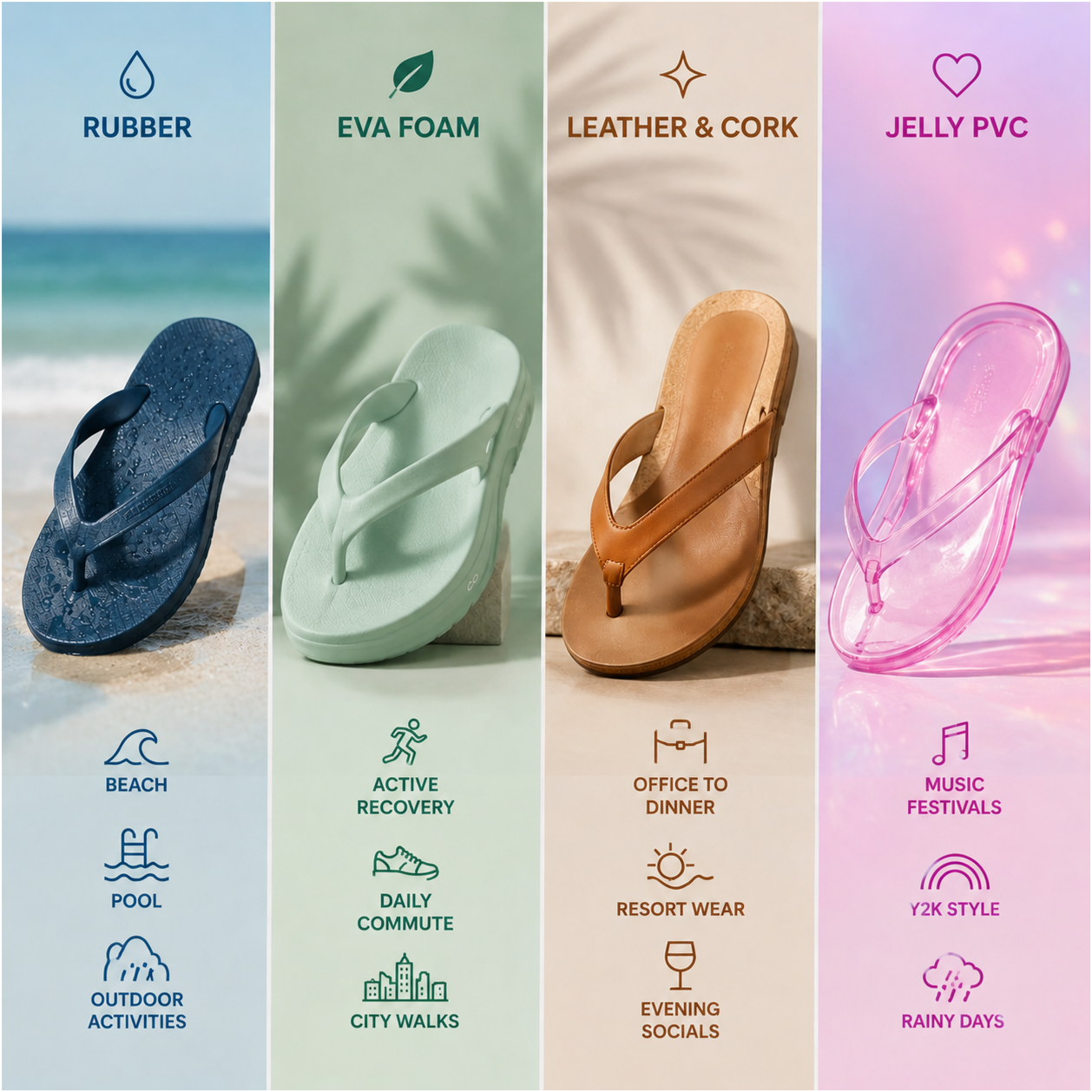
For years, flip-flops were easy to categorize.
They were inexpensive summer footwear, usually made from simple rubber, PVC, or foam, and mainly associated with beaches, swimming pools, holidays, and casual weekends. For many footwear buyers, the category was primarily about price, color, and basic comfort.
That perception is changing.
Today, flip-flops are appearing in a much wider range of consumer situations, from post-workout recovery and city commuting to resort dressing and fashion-focused summer collections. More importantly for footwear manufacturers, wholesalers, importers, and private-label brands, the market is becoming increasingly segmented by sole material and product function.
A flip-flop designed for a beach store does not necessarily need the same construction as one developed for an urban lifestyle brand. A recovery-oriented foam sandal requires a different product proposition from a fashion-led leather thong sandal.
For B2B buyers, this shift creates both an opportunity and a challenge: the right material is no longer simply a production decision. It is becoming part of the product's market positioning.
From Basic Summer Footwear to a Multi-Segment Product
The biggest change in the flip-flop category is not necessarily the disappearance of traditional products. Rubber and simple foam flip-flops remain commercially important. The change is that new product tiers are being built around different customer expectations.
Consumers increasingly want their footwear to fit a specific moment in their day.
A shopper going to the beach may prioritize water resistance and traction. Someone walking around a city for several hours may look for lightweight cushioning. A fashion consumer may care more about the appearance of the footbed, straps, color palette, and overall silhouette.
This has important implications for B2B product development.
Instead of asking, “What kind of flip-flop should we produce?”, buyers are increasingly asking, “Who is going to wear it, where will they wear it, and what material communicates that value?”
That is why material selection deserves more attention when brands develop their next sandal collection.
1. Rubber Soles Remain Strong in Water and Outdoor Categories
Natural and synthetic rubber continue to be highly relevant in the traditional flip-flop market, particularly for beach, pool, travel, and outdoor applications.
The reason is straightforward. Rubber can offer a combination of flexibility, durability, grip, and resistance to everyday exposure to water. Havaianas, for example, continues to build its classic flip-flop proposition around rubber outsoles, while its current product range includes both traditional styles and more fashion-oriented variations.
For B2B buyers, rubber remains attractive because it can support several commercial segments without completely changing the basic construction.
Beach retailers can focus on bright colors and seasonal prints. Resort brands can introduce cleaner, more premium color palettes. Outdoor-oriented collections can emphasize traction and durability.
The opportunity is therefore not simply “rubber flip-flops.”
It is rubber flip-flops developed for a clearly defined environment.
This distinction matters when factories and brands discuss specifications. Sole hardness, outsole texture, tread design, strap construction, logo application, and color matching can all influence the final positioning of the product.
For rainy climates and water-related markets, buyers may also want to place greater emphasis on surface grip. In these cases, the outsole pattern becomes just as important as the material itself.
2. EVA and Advanced Foams Are Expanding the Comfort Market
Foam-based footwear is another area where the traditional image of the flip-flop is changing.
EVA has long been used in slides, sandals, and casual footwear because it is lightweight, flexible, and relatively easy to mold into different shapes. But newer product development is increasingly focused on creating a more structured comfort experience rather than simply making footwear light.
The recovery footwear category is a useful example.
OOFOS has helped demonstrate how foam footwear can be positioned around recovery rather than basic leisure. Its products use OOfoam technology and emphasize shock absorption, foot support, lightweight construction, and a biomechanically designed footbed. The company's current assortment also includes both slides and thong-style sandals, showing that the recovery concept can extend beyond one traditional sandal silhouette.
This creates an interesting opportunity for private-label brands and footwear importers.
A foam flip-flop does not necessarily have to compete at the lowest price point. With the right geometry, density, footbed construction, and branding strategy, the same broad material family can become part of a comfort-focused collection.
For manufacturers, however, this means the conversation should move beyond “EVA or not EVA.”
Buyers need to evaluate foam density, rebound, compression resistance, footbed geometry, weight, surface texture, and outsole durability. These technical factors can make a significant difference in how the finished product feels and performs.
Sustainable foam materials are also becoming part of the conversation. Bio-based alternatives, including sugarcane-derived materials used in footwear, have helped introduce another product message: comfort combined with a lower-impact material story.
For B2B customers, this can be especially relevant when developing collections for consumers who expect sustainability to be part of the product narrative rather than an afterthought.
3. Leather and Cork Are Changing the Perception of Flip-Flops
Perhaps the most visible shift is happening at the fashion end of the market.
Leather flip-flops and sandals are no longer restricted to basic resort collections. Minimalist silhouettes, muted colors, elevated footbeds, and refined straps are allowing thong sandals to appear in wardrobes where simple rubber footwear may previously have looked too casual.
This is where the influence of “quiet luxury” and understated fashion becomes commercially interesting.
The product does not necessarily need a large logo or complicated decoration. Instead, the perceived value can come from material quality, proportions, construction, finishing, and the overall shape of the sandal.
For B2B buyers, that means leather and cork-footbed products can target a very different retail environment from conventional beach flip-flops.
A fashion retailer may pair a slim thong sandal with dresses or wide-leg trousers. A resort brand may use natural colors and textured materials to create a premium vacation collection. A lifestyle label may position the same basic footwear category as a day-to-evening product.
This also changes the product development process.
A premium-looking sandal cannot rely solely on expensive upper material. The outsole, footbed, edge finishing, hardware, stitching, packaging, and color selection all need to support the intended price point.
In other words, premium positioning has to be visible in the complete product, not just in the material name.
4. PVC and Jelly Styles Bring Color Back Into the Category
At the opposite end of the aesthetic spectrum, PVC, TPU, and translucent synthetic materials offer a completely different opportunity.
Jelly footwear has a strong connection with late-1990s and early-2000s fashion, and the visual character of translucent materials makes them particularly useful for seasonal fashion programs.
Unlike leather, which tends to communicate refinement, translucent synthetics can communicate fun, nostalgia, color, and youth.
That makes the category interesting for festival collections, summer fashion, holiday footwear, and trend-driven collaborations.
The material itself becomes part of the visual design.
Transparent straps can create a barely-there appearance. Bright translucent colors can become the key feature of the product. Metallic details, glossy surfaces, decorative components, or playful shapes can push the product further into the fashion category.
From a manufacturing perspective, however, these materials require careful attention to finishing and color consistency.
A translucent product can make imperfections more visible than a conventional opaque sandal. Injection quality, surface appearance, component matching, and color stability therefore become important considerations during sampling and production.
For brands selling into younger consumer segments, this may be an attractive way to turn the familiar flip-flop shape into a more fashion-oriented product.
What This Means for B2B Footwear Buyers
The most important lesson is that the flip-flop market is becoming less about one universal product and more about multiple consumer niches.
For manufacturers, this creates room for OEM and ODM development.
Instead of offering only a fixed catalogue of standard styles, suppliers can develop different material platforms around specific market requirements.
A rubber construction may be suitable for a beach and pool collection.
A lightweight molded foam platform can serve an active lifestyle or recovery-oriented range.
A leather or cork footbed can support a more premium fashion collection.
A translucent synthetic construction can target younger, trend-sensitive consumers.
This approach can also help brands reduce product development risk.
Rather than launching a large number of unrelated designs, buyers can create a focused collection where each material has a clear reason to exist.
That makes merchandising easier, strengthens the product story, and gives retailers a more understandable reason to stock multiple styles.
The Opportunity for Custom Development
For OEM and ODM suppliers, this trend creates opportunities beyond simple manufacturing.
Brands increasingly need help with material recommendations, sole construction, color development, logo placement, footbed design, packaging, and production feasibility.
A buyer may arrive with a visual reference but without a finalized technical specification. A capable factory can help translate the concept into a manufacturable product.
For example, a fashion-oriented buyer may want the appearance of a leather sandal but the cost and weight advantages of synthetic materials. Another customer may want an EVA flip-flop with a more supportive footbed and improved outsole traction. A resort brand may request a rubber sole with customized strap colors and seasonal branding.
These projects require more than production capacity. They require knowledge of materials and product construction.
That is why supplier selection is becoming increasingly important in this category.
The ability to offer multiple sole materials, flexible development support, reliable sampling, color matching, mold development, and consistent mass production can give B2B suppliers a significant advantage.
Where the Flip-Flop Category Is Heading
The flip-flop is not disappearing into a more complicated sandal category. Instead, the category is expanding.
Its basic silhouette remains simple, but the consumer expectations around it are becoming much more diverse.
One customer may want a waterproof rubber flip-flop for the beach. Another may want an ultra-light foam sandal for everyday walking. A fashion consumer may prefer a slim leather style. A younger shopper may choose a translucent jelly sandal simply because it fits the visual language of current summer fashion.
For B2B buyers, this means the future of the category is unlikely to be determined by one material, one price level, or one customer profile.
The real opportunity lies in matching material + construction + function + consumer scenario.
That is where product development becomes more strategic.
Flip-flops may have started as one of the simplest products in footwear, but their next stage is far more sophisticated. For brands, wholesalers, retailers, and footwear manufacturers, the question is no longer whether flip-flops are fashionable or functional.
The more useful question is: What should a flip-flop do for the consumer, and which material can deliver that promise most convincingly?
That answer will shape the next generation of flip-flop collections.

Contact Us