
Recycled Materials in Flip Flops: The Future of Sustainable Footwear
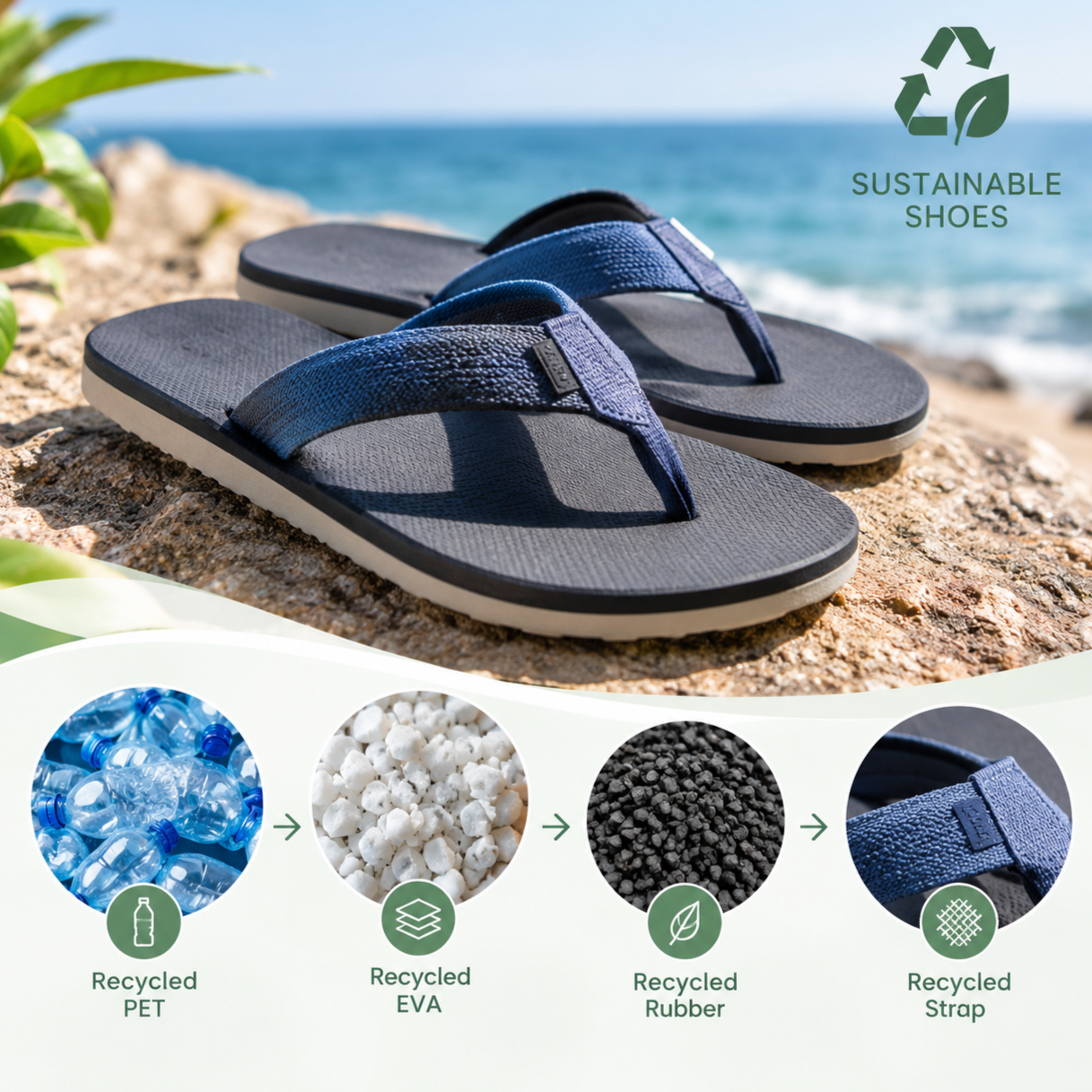
Sustainability is moving from a niche concept to a practical consideration in footwear development. For brands looking for sustainable shoes, the challenge is no longer simply choosing an environmentally preferable material. The bigger question is how recycled materials can be integrated into a commercial footwear product without compromising comfort, durability, appearance, or production efficiency.
Flip flops are an interesting category for this transition. Their relatively simple construction makes it possible to experiment with recycled foam, recycled polyester, rubber compounds, and other lower-impact materials. Today, recycled content can be incorporated into the sole, footbed, straps, and even packaging.
For brands developing mens flip flops, beach sandals, casual footwear, and private-label collections, understanding these materials and manufacturing processes can help turn sustainability from a marketing statement into a measurable product feature.
Why Recycled Materials Matter in Footwear
Footwear is a complex product because a single pair can contain several different materials, including EVA, rubber, polyester, PU, adhesives, textiles, and hardware. This material diversity makes recycling at the end of a shoe's life more difficult.
A 2026 Fashion for Good project examining post-consumer footwear found that 50% of collected post-consumer footwear was classified as non-rewearable, while another 46% was rewearable. The project also found that 37.7% of non-renewable sole materials in the non-rewearable fraction could not be identified using NIR scanning. These findings demonstrate why material selection and product design are becoming increasingly important for footwear circularity.
For flip flops, using recycled material at the manufacturing stage can be a relatively practical first step. Factory production waste, such as EVA scraps, trimming waste, and molding runners, can potentially be collected, processed, and incorporated into new footwear components.
1. Recycled EVA: One of the Most Practical Options for Flip Flops
EVA, or ethylene-vinyl acetate, is widely used in footwear because it is lightweight, flexible, and capable of providing cushioning. It is particularly common in flip-flop soles and footbeds.
During injection molding, EVA material is heated and injected into a mold. The process can generate gates, runners, and other production scraps. Instead of sending all of this material to waste, manufacturers can collect, sort, grind, and reprocess suitable EVA scrap.
Research published in The International Journal of Advanced Manufacturing Technology investigated recycled EVA for footwear. In the study, pre-vulcanized EVA waste was shredded and incorporated into virgin EVA at a 10% recycled content level. The resulting material showed somewhat lower mechanical performance than virgin EVA, but the researchers concluded that the approach offered significant environmental and cost-sustainability benefits.
The basic manufacturing flow can be:
EVA production scrap → sorting → cleaning → shredding/grinding → particle-size control → blending → molding → testing
The percentage of recycled material depends on the required performance, material type, color, density, and construction of the flip flop. For a fashion-oriented beach flip flop, recycled content may be easier to introduce than in a highly technical outdoor sandal where abrasion and traction requirements are higher.
2. Recycled PET for Flip Flop Straps
Another practical application is recycled polyester made from post-consumer plastic bottles.
PET bottles can be collected, cleaned, sorted, processed into flakes, and converted into polyester fibers. These fibers can then be spun into yarn and woven or knitted into sandal straps.
This is particularly useful when developing soft textile straps for casual or lifestyle flip flops.
Commercial footwear already demonstrates that recycled PET can move beyond laboratory development. REI's Recycled Thin-Strap Flip-Flops, for example, use recycled PET polyester in the straps and recycled foam in the sole construction. The product uses different foam densities for the footbed, structural area, and outsole, showing that recycled material can be engineered around different performance requirements.
For men's flip flops, recycled polyester webbing can offer another design advantage: the strap can be customized in color, weave, width, texture, and branding.
3. Recycled Rubber and Rubber Compounds
Rubber is another material with potential for recycled content.
For flip flops designed for outdoor, travel, or everyday walking, the outsole needs a balance of flexibility, abrasion resistance, and traction. Recycled rubber can be incorporated into selected outsole compounds, depending on the performance requirements.
The key is not simply to maximize recycled content. A commercial outsole still needs to pass the required durability and slip-resistance tests.
A more practical approach is often to optimize the compound by combining recycled rubber with virgin rubber and other ingredients. This allows manufacturers to control hardness, abrasion resistance, flexibility, color, and processing performance.
4. From Recycled Material to Finished Flip Flop
Using recycled materials does not mean simply replacing virgin material with recycled material.
A successful recycled flip flop requires control at several stages.
Step 1: Material Sorting
Different production scraps need to be separated by material type. EVA, rubber, polyester, and other materials should not automatically be mixed together.
Step 2: Cleaning and Processing
Scrap material is cleaned and mechanically processed. For EVA, this generally includes shredding or grinding into smaller particles.
Particle size is important because inconsistent particles can affect material mixing and the final appearance of the sole.
Step 3: Material Blending
Recycled material may be blended with virgin material to achieve the required physical properties.
The formulation can be adjusted according to the intended product. A lightweight home or beach flip flop may have different requirements from a men's outdoor flip flop intended for extended walking.
Step 4: Molding
After material preparation, the compound can be processed through the appropriate molding system.
For EVA components, injection molding is widely used. The material is heated, injected into the mold, expanded or formed as required, and then cooled.
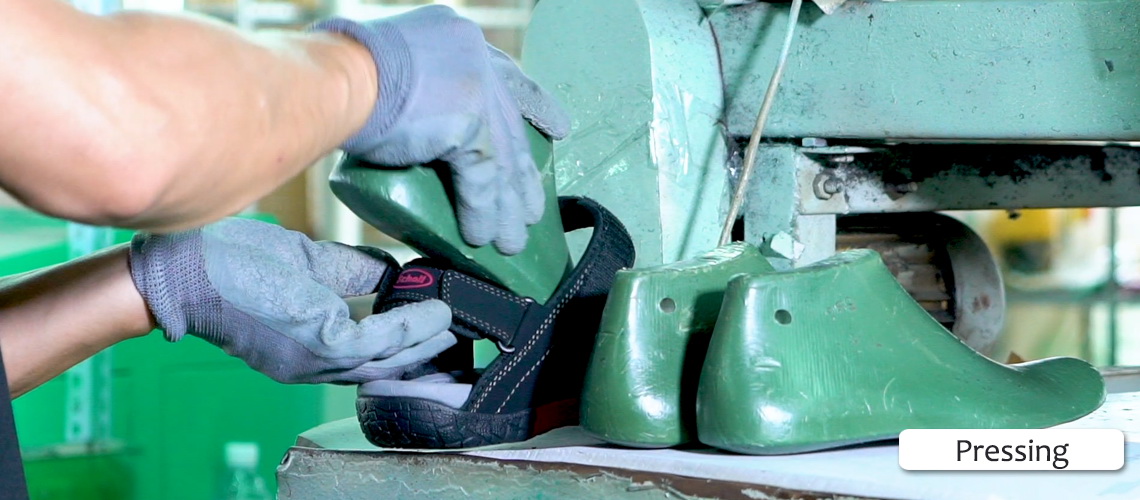
Step 5: Finishing and Assembly
After molding, components are trimmed and inspected before assembly. Depending on the construction, the straps may be inserted, attached, stitched, bonded, or mechanically fixed.
Finally, the completed flip flops are inspected for dimensions, appearance, bonding, hardness, color, and other quality requirements.
The Latest Development: Designing EVA for Recycling
One of the most interesting developments is that researchers are looking beyond simply recycling conventional EVA waste.
A major challenge is that conventional crosslinked EVA foam has a permanent network structure, which makes repeated recycling difficult. Research published in 2026 explored vitrimer-enabled EVA foams, a new approach designed to make EVA foam more suitable for repeated reprocessing.
In the reported experiments, the vitrimer EVA foam was able to undergo three thermomechanical recycling cycles. After two recycling cycles, compression-set recovery improved by 50%, although expansion decreased to approximately 65%. This research is still an emerging technology rather than a universal commercial solution, but it points toward a future in which footwear foams could be designed with recyclability in mind from the beginning.
This is an important shift in thinking.
The future of sustainable footwear may not simply be:
“Use recycled material.”
It may increasingly become:
“Design the material so the product can be recycled again.”
Current Commercial Applications
The market is already moving in this direction.
Teva's ReFlip sandal uses recycled content across multiple components, including recycled polyester webbing, 30% recycled EVA in the topsole, and 30% recycled EVA in the outsole. This demonstrates how recycled content can be distributed across a product instead of being limited to one small component.
Allbirds has also applied a different approach to flip flops. Its flip-flop construction combines a recycled-polyester blend in the strap with a sugarcane-based EVA cushioning material and a natural-rubber outsole. This illustrates another major trend: sustainability is increasingly based on a material portfolio, rather than relying on one “green” material.
For manufacturers and brands, this opens up several possible development directions:
- Recycled EVA footbeds
- Recycled EVA outsoles
- Recycled PET straps
- Recycled rubber outsole compounds
- Bio-based foam combined with recycled materials
- Recycled production waste
- Mono-material or simplified constructions
- Recyclable packaging
- Product designs that make future disassembly easier
What Is the Next Trend for Sustainable Shoes?
The next stage of sustainable footwear is likely to focus on traceability, recycled content, circular design, and measurable claims.
Fashion for Good's current footwear circularity work identifies materials, design, end-of-use recycling, and traceability as four important areas for improving footwear sustainability.
For footwear brands, this means that simply saying “eco-friendly” may become less persuasive. Buyers increasingly want to know:
What material was recycled?
Where did it come from?
What percentage is recycled?
How was it processed?
Does the finished product maintain acceptable durability?
Can the product itself be recycled at the end of its life?
These questions are particularly relevant to B2B footwear development, where brands need reliable specifications for product pages, packaging, compliance documents, and sustainability reporting.
What This Means for Men's Flip Flops
For mens flip flops, recycled materials can be integrated without changing the basic consumer experience.
A practical development may combine a recycled EVA sole with a recycled polyester strap. A more performance-oriented model could combine recycled EVA with a rubber outsole compound. A lifestyle model could use recycled textile straps and a bio-based or recycled foam footbed.
The most suitable solution depends on the target market, retail price, product positioning, performance requirements, and sustainability claims that the brand wants to make.
The important point is that sustainability should not be treated as an isolated material choice. It should be considered during the entire product-development process—from material selection and mold design to production, quality control, packaging, and eventual end-of-life management.
Conclusion
Recycled materials are becoming a practical part of modern flip-flop development.
Recycled EVA can make use of suitable footwear production waste. Recycled PET can transform discarded plastic bottles into durable textile straps. Recycled rubber can be incorporated into selected outsole compounds. At the same time, new material technologies are exploring how EVA itself can become easier to recycle repeatedly.
For brands developing sustainable shoes, the opportunity is not simply to create a flip flop with recycled content. The bigger opportunity is to develop footwear where material selection, manufacturing efficiency, durability, and end-of-life considerations work together.
As circular footwear technology continues to develop, flip flops—with their relatively simple construction and high-volume production—could become one of the practical categories for testing and scaling new recycled-material solutions.



Contact Us